
May 10th 2026
What is Eid al-Adha? The Festival of Sacrifice Explained
It is morning time. You hear the phrase "Allahu Akbar" being said outside. Your neighbors are dressed up nicely. There is an aroma of meat in the air.
Your friend, who is not a Muslim, asks, "What is happening? Are we celebrating Eid?"
You respond: "Yes, it is Eid al-Adha.
They ask "What? I thought that Eid was after Ramadan?
You pause. What makes you think this? Ibrahim's story. The sacrifice. The pilgrimage. The celebration.
Where's the beginning?
I can still recall the first Eid al-Adha in a western country. The next day, went to work. Colleague: How was your break?
I replied: "Eid al Adha.
Blank stare. "What's that?"
I blundered on through an explanation. “It is like we sacrifice animals remember Abraham it is connected with Hajj...”
A not-so-clean explanation.
I was able to improve the way I explained it over the years. Not only what we do. But why. The meaning. The history. The beauty of it.
Let's go through this explanation. If you are Muslim and you want to tell non-Muslims all about Eid. Or a non-Muslim wanting to learn about the Muslim celebration.
It's Eid al-Adha. Festival of Sacrifice. One of the most important festivals of Islam.
Meaning of the Name: What does ‘Eid al-Adha’ mean?
‘Eid’ – means ‘Festival’, ‘Celebration’, and ‘Recurring Happiness’
‘Al-Adha’ – means the sacrifice, the offering
Together: Festival of Sacrifice
Other names of this festival include:
‘Eid al-Kabir’ (The Greater Eid)
The Goat Eid (South Asian Name)
Choose the festival that is celebrated in your native language. Select the festival you celebrate in your native language.
A West African expression for tabaski.
Why "Greater Eid"?
Some people refer to it as Greater Eid because:
It is linked to the pilgrimage (Hajj).
4 days are observed for the rituals (1-3 are observed during Eid al-Fitr)
Though both Eids are equally important in their own ways.
So When is Eid al-Adha?
The Date:
The 10th day of the month of Dhul Hijjah (12th and last month of the Islamic calendar).
Islamic Calendar:
Lunar calendar. Based on the appearance of the moon. Approximately 11 days shorter than the solar year.
What This Means:
Eid al-Adha moves backward through the seasons each year. One year it's in summer. Next year late spring. Eventually it cycles through all seasons.
Calculating the Date:
Islamic months are initiated when the new moon is seen. Some countries may honor on different days (one day later) based on moon sighting.
The Duration:
It is a 4-day celebration:
This is followed by the day of Eid (10th Dhul Hijjah)
11th, 12th, 13th Dhul Hijjah (days of Tashriq)
These days are days of celebration for families. Visiting. Feasting. Giving charity.
In regards to the course of Hajj:
Eid al-Adha is during the period of the Hajj. Millions of people make a pilgrimage to Makkah, while all the other Muslims celebrate Eid.
Muslims around the world do the same (except the stoning), same day pilgrims stone the Jamarat and offer sacrifice.
Fatima added: "My brother made his Hajj one year and we celebrated Eid at home, and on that same day, at the same time (accounting for time zones) he was in Mina making his sacrifice and we sacrificed here, and that connection, millions of Muslims around the world making the same sacrifice, it makes me shiver. The connection between two events creates a feeling of fear that overcomes me when I see so many Muslims throughout the world perform the same act of sacrifice.
The Story: Why Do We Celebrate?
Prophet Ibrahim (Abraham) is the story behind Eid al-Adha.
The Background:
Ibrahim was a prophet. Devoted to Allah. He had longed for a son for years. Finally, in old age, Allah blessed him with Ismail (Ishmael).
Ibrahim was very fond of Ismail. His miracle child. His joy.
The Dream:
Ibrahim dreamed a dream. In this dream, he was offering his beloved son to God.
Prophets' dreams are revelation. Allah’s command.
Imagine the test. Sacrifice your son? The prayer answered child? Your miracle? Your beloved?
The Conversation:
Ibrahim replied to Ismail: "O my son, I have seen in a dream that I must sacrifice you. What do you think?"
Ismail replied, "O my father, do as you are commanded. You will find me, if Allah wills, among the patient."
The son submitted. The father submitted. Both willing. Both trusting Allah.
The Sacrifice:
Ibrahim put down Ismail. Prepared to sacrifice him. Knife at the throat.
Allah intervened at that time. Sent Angel Jibreel (Gabriel) and a ram.
"O Ibrahim, you have fulfilled the vision." (Qur'an 37:104-105)
Rather, the ram was sacrificed. Ismail was saved.
The Lesson:
This wasn't about Allah wanting Ibrahim to kill his son. It was about testing absolute submission.
Ibrahim proved: I love Allah more than anything. Even my precious son. When Allah says, do it, I do it.
That's the pinnacle of faith. Complete surrender. Total trust.
We Commemorate This:
Each time we sacrifice an animal during the feast of Eid al-Adha to remember Ibrahim's sacrifice of all things for Allah.
We say: "We submit like Ibrahim, and we trust like Ismail, anything Allah commands, we do.
When I explain the concept of Eid al-Adha to non-Muslims some are shocked: 'God asked him to sacrifice his son? I explain: God tested His willingness, then He stopped him, it is a matter of willingness to sacrifice; not actually killing. God doesn't want human sacrifice, He wanted proof of absolute love.
What Do Muslims Do? The Rituals!
1. Eid Prayer
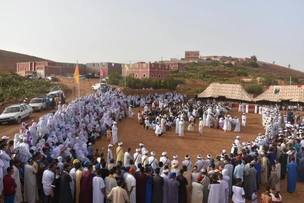
The day is the morning of the 10th of Dhul Hijjah. Before noon following the sunrise.
Location: Big outdoor prayer area or mosque.
How:
Extra takbirs (saying Allahu Akbar)
Imam delivers khutbah (sermon) after the prayer
Specific duas for Eid and prayers.
Special Features:
No adhan (call to prayer) prior to Eid prayer
Wear best clothes
Apply perfume
Go to prayer ground walking (if possible)
Take alternate way home from a different route you came from.
The Sermon:
Focuses on:
Ibrahim's sacrifice
What it means to submit:
Importance of Qurbani
Unity of Muslims worldwide
Gratitude to Allah
2. The Sacrifice (Qurbani/Udhiyah)
What: Any kind of animal that is raised for food (goat, sheep, cow, buffalo, or camel).
Who: Required for those who can afford it (possess nisab - minimum wealth threshold).
Where: It is offered after the prayer of Eid on the 10th of Dhul Hijjah or during the next 3 days (11th, 12th, 13th).
The Animal:
The Goat/Sheep minimum age is 1 year old.
Suggested minimum age for cow/buffalo: 2 years old.
Cattle: 5 years old minimum
Must be healthy, have no serious defects
Distribution: Traditionally divided into thirds:
One-third for your family
One-third for friends/relatives
Give one-third to the poor.
The Meaning:
Not just ritual slaughter. It's:
Remembering Ibrahim's sacrifice
Submitting to Allah's command
Giving to the less fortunate
Teaching children generosity
Following prophetic tradition
3. Festive Celebrations
Family Gatherings:
Families come together. Extended family. Friends. Neighbors.
Share meals. Exchange gifts. Visit each other.
New Clothes:
Children (and adults) put on new / best clothes. A part of the jubilation and happiness.
Eid Greetings:
"Eid Mubarak!" (Blessed Eid) Taqabbal Allahu minna wa minkum – may Allah accept from us and from you
Special Foods:
There are traditional foods for Eid in each culture. Biryani. Kebabs. Sweets. Cookies.
The meat of the sacrifice is frequently prominently displayed in the feast.
Giving to the Poor:
Extra charity. Providing meat and for everyone, even the poorest, be able to celebrate.
When providing care for the Sick and Elderly:
Making visits to those who are unable to leave home. Taking them food and happiness.
Zaynab said: "The morning of Eid al-Adha is a whirl of activity in our home, as the children cheerfully run around, the meat is put together, the guests arrive, the food is cooked, but about the chaos? It's beautiful and family, and it's tradition, and it's remembering that we are blessed enough to sacrifice and share.
The Spiritual Significance
What is the spiritual significance of Eid al-Adha, aside from the rituals?
1. Submission to Allah
Ibrahim was willing to give his son up. We sacrifice animals. Both acts mean: Allah's first. Above our desires. Above our attachments. Above everything.
2. Detachment from Materialism
You are losing a valuable thing (an animal, or money to acquire one). Teaching yourself: Wealth is for Allah's sake. Not hoarding. Sharing.
3. Show understanding of the poor's situation.
The meat distribution helps even the poorest families to have meat. You experience giving. They experience receiving. Community bonds strengthen.
4. Gratitude
Ibrahim was happy with his son. We're grateful for our blessings. The sacrifice is thanksgiving. Alhamdulillah, I have been provided with so much.
6. Unity of the Ummah
It's a universal celebration for Muslims throughout the world. Do the same sacrifice. Become more connected across distance.
Indonesia to Morocco. Starting from South Africa to Canada. All: It is not possible to say "Allahu Akbar" and sacrifice for Allah.
6. Following Prophetic Tradition
The Prophet (peace be upon him) did Qurbani. We follow him. Linking to a millennium of Islamic history.
My children asked me, 'Why do we give away the meat? We paid for it!' I explained, 'That's the point. We give up what's valuable. That's sacrifice. That's generosity. That's what Ibrahim taught us. Now they help to share meat with neighbours, they're learning the lesson.
Common Questions Non-Muslims Ask
Q: "Isn't animal sacrifice cruel?"
A: Islamic slaughter method (dhabihah) has been created to minimize suffering:
Sharp knife
Swift cut
The animal becomes unconsciousness right away.
No torture or prolonged pain
Made with respect and in Allah's name
Sacrifice is not as much as suffering involved in modern meat industry.
Q: "Why kill animals? Why not simply give money?
A: It's specifically commanded. Following Ibrahim's example. The act itself does have a spiritual meaning other than monetary.
Many Muslims also give money to have sacrifices made on their behalf (particularly in poorer nations).
Q: "What do you do with all that meat?
A: Distributed. Eaten. Distributed among the very poor. Very little waste. It's all about sharing, not over-sharing.
Q: "Do you have to sacrifice?"
A: If one has the ability to afford it (has minimal wealth threshold). Otherwise, it's not obligatory.
Q: Is it like Thanksgiving?
A: Some differences (exemptions, restrictions, peace, war). However, the act of sacrifice of Ibrahim is celebrated in Eid al-Adha, which is not so much a cultural celebration as a religious duty.
Q: "How is it different from Eid al-Fitr?"
A: Eid al-Fitr is the celebration of the end of Ramadan (fasting month). Eid al-Adha is a celebration of Ibrahim's Sacrifice and it falls along Hajj. Various occasions, various importance.
How Different Cultures Celebrate
It's the same around the globe. However, there are cultural variations.
Middle East:
Large family gatherings
Whole lamb/goat roasted
Sweets traditionally made (baklava, kunafa)
Often visiting several relations for 3-4 days.
South Asia:
Feast is dominated by Biryani and kebabs.
Elaborate meat dishes
For women and girls, Mehndi (henna) is made.
Supply to many needy households
Africa:
Community-wide celebrations
Shared sacrifices
Traditional music, dance (halal forms)
A focus on solidarity within the community.
Western Countries:
Putting together local sacrifice facilities
Reducing the number of hours worked (where possible)
Exhibitions and events that require rental facilities within the Islamic community
Talking to other curious neighbors about the celebration.
Turkey:
In addition, there is a national holiday of Kurban Bayramı (4 days).
Family visits
Traditional Turkish foods
Children are given gift of money and gifts.
Omar said: “In Pakistan, where I'm from, Eid was huge with everyone home, streets full of animals before Eid, huge feasts, in America it was subdued, but we've made our traditions, community Eid prayers, potluck after, organizing group sacrifices, making it work.”
The Connection to Hajj
The two festivals of Eid al-Adha and Hajj are intertwined.
Same Days:
On the day of Muslims' Eid around the world (10th Dhul Hijjah):
Stoning the Jamarat
Offering their sacrifice
Shaving their heads
Completing the significant parts of the rite of Hajj.
Same Sacrifice:
It is the duty of a pilgrim at Hajj to make sacrifices. Muslims worldwide also offer sacrifice (if they are able to). Synchronized worship.
Spiritual Connection:
Even if you aren't in Makkah, celebrating Eid al-Adha helps you be connected to those doing Hajj. You are a member of world-wide worship.
The Day of Arafat:
Eid (9th Dhul Hijjah) is the following day after the Day of Arafat. Here, at the top of Hajj, pilgrims stand.
The day before Eid (9th Dhul Hijjah) is the Day of Arafat. Pilgrims stand at Arafat—the pinnacle of Hajj.
For non-pilgrims, it's a recommended day to fast. Fasting on this day expiates sins of the previous and coming year.
Then Eid the next day. Celebration after the intensity of Arafat.
Lessons from Eid al-Adha
What should we take away from this celebration?
1. Nothing is More Important Than Allah
Ibrahim loved his son. But when Allah commanded, he obeyed. Our love for Allah should surpass all other loves.
2. Sacrifice is Part of Faith
We must be willing to sacrifice our:
- Wealth (through Qurbani and charity)
- Desires (through obedience)
- Comfort (through worship)
- Time (through devotion)
3. Provision Comes from Allah
Ibrahim trusted: If I sacrifice my son, Allah will provide. Allah did—with the ram. When we sacrifice for Allah, He provides in ways we can't imagine.
4. Obedience Without Understanding
Ibrahim didn't understand why. But he obeyed. Sometimes Allah's wisdom is beyond our comprehension. We trust and obey anyway.
5. Generosity Creates Community
The meat distribution. The visiting. The sharing. Eid al-Adha strengthens community bonds. We're responsible for each other.
6. Celebration is Worship
Joy. Feasting. New clothes. These aren't distractions from worship. They ARE worship when done with right intention. Allah wants us to celebrate His blessings.
7. Inclusion of the Less Fortunate
No one should be left out. Even the poorest receive meat. Even the lonely receive visits. That's Islamic brotherhood.
Conclusion: More Than Just a Festival
Eid al-Adha isn't just about sacrificing animals. It's about sacrificing ego. Selfishness. Attachment to dunya (worldly life).
It's about saying: "Allah, You come first. Before my wealth. Before my desires. Before everything."
It's about remembering Ibrahim—an old man willing to sacrifice his miracle son because Allah commanded.
It's about community. Ensuring everyone has meat. Everyone celebrates. No one is forgotten.
It's about gratitude. "Thank you, Allah, for blessing me enough that I can sacrifice and share."
It's about worship. From the Eid prayer to the sacrifice to the feast—all done for Allah's sake.
When you see Muslims celebrating Eid al-Adha:
Dressed in their best. Saying "Allahu Akbar." Sacrificing animals. Sharing meat. Visiting family. Giving to the poor.
Know that they're not just following tradition. They're living theology. They're embodying submission. They're remembering Ibrahim. They're saying: "We too will sacrifice what we love for the One we love most."
That's Eid al-Adha. The Festival of Sacrifice.
May Allah accept our sacrifices. May He grant us the faith of Ibrahim. And may we celebrate Eid with joy, gratitude, and sincere submission.