
May 11th 2026
Story of Prophet Ibrahim
Every Eid al-Adha, we sacrifice animals. Every Hajj, we circle the Ka'bah. Every prayer, we send blessings upon Prophet Muhammad and "the family of Ibrahim."
But who was Ibrahim? What did he do that made him so central to Islam?
You know the basic story. Broke idols. Was thrown in fire. Sacrificed his son (or was about to).
But there's so much more. Tests you've never heard about. Struggles that break your heart. Faith that transforms nations.
I grew up knowing Ibrahim as "the guy who broke the idols." That's it. A one-dimensional figure from ancient history.
Then I studied his life properly. Read the Qur'anic verses. The details. The human moments.
Now he was not just “that man who broke the idols.” No, now he was “the man who left his father for Allah.” He was “the man who was thrown into fire but didn’t get burned.” He was “the man who left his family in the desert because he trusted in Allah.”
The man whose every test makes your own struggles seem small.
Let me tell you his story. Not as distant history. But as a living example. A man who faced impossible choices and chose Allah every single time.
Because knowing Ibrahim? That's understanding half of Islamic history.
His Birth: Growing Up Among Idol Worshippers
The Context:
Born in Ur (in present-day Iraq) or Babylon (scholars differ on exact location). Approximately 2000 BCE.
His father: Azar (or it was his uncle, scholars differ). A man who made and sold idols.
His people: Worshipped stars, moon, sun, and man-made idols.
Young Ibrahim:
Growing up surrounded by idol worship. But something in him questioned.
Everyone else bowed to statues. He asked: "Why?"
Everyone else worshipped stars. He observed: "They set. How can gods set?"
Born into darkness. But seeking light from childhood.
Dr. Ahmed explained: "Ibrahim's genius was questions. He didn't just accept what he was born into. He questioned. 'Why do we worship these statues? Did they create themselves? Do they provide for us?' That critical thinking—that's what made him Ibrahim."
The Search for Truth: Questioning the Stars
The Qur'an tells us about Ibrahim's intellectual journey.
He Observed the Stars:
"When the night covered him, he saw a star. He said, 'This is my lord.' But when it set, he said, 'I do not like those that set.'" (Qur'an 6:76)
Then the Moon:
"When he saw the moon rising, he said, 'This is my lord.' But when it set, he said, 'If my Lord does not guide me, I will surely be among the people gone astray.'" (6:77)
Then the Sun:
"When he saw the sun rising, he said, 'This is my lord; this is greater.' But when it set, he said, 'O my people, indeed I am free from what you associate with Allah.'" (6:78)
His Conclusion:
"Indeed, I have turned my face toward He who created the heavens and the earth, inclining toward truth, and I am not of those who associate others with Allah." (6:79)
What This Shows:
Logical progression. Observation. Reasoning. Conclusion.
Not out of blind faith, but wisdom in accepting submission before the Being who made all these celestial beings.
Fatima told me that she asked her son, “How do we prove that God exists?” Her reply was through the life of Ibrahim. How he used logic, by studying nature to prove the existence of the Creator.
Breaking His Father’s Idols: The First Act of Defiance
The Confrontation:
Ibrahim told his father: "O my father, why do you worship that which does not hear and does not see and will not benefit you at all?" (19:42)
His father's response: "Do you dislike my gods, O Ibrahim? If you do not desist, I will surely stone you. So avoid me for a prolonged time." (19:46)
Imagine:
Your own father threatening to stone you. For believing in One God.
Ibrahim's Response:
"Peace be upon you. I will ask forgiveness for you from my Lord. Indeed, He is ever gracious to me." (19:47)
He left. Left his father. Left his home. For Allah.
The Idol-Breaking Incident:
His people were having a festival. Everyone left town. Ibrahim stayed back.
He visited the temple of the idols. He destroyed all the idols except for the biggest one. He left his axe hanging from him.
The people came back and when they saw what happened, Ibrahim told them: “Ask the biggest one. Maybe he did it.”
The Point:
Exposing the absurdity. Your gods can't protect themselves? Can't speak? Can't do anything? Why worship them?
The people knew he was right. But pride prevented admission.
Ahmed said: "I love Ibrahim's courage. He didn't just debate. He took action. Destroyed their false gods physically. Proved they're powerless. That takes guts. That's what we need today—Muslims willing to stand for truth even when it costs everything."
Thrown Into the Fire: The Ultimate Test
The Reaction:
The people were furious. Their gods destroyed. Their beliefs challenged. Their traditions mocked.
They decided: "Burn him and support your gods, if you are going to do anything." (21:68)
The Fire:
They built a massive fire. So large and hot, they couldn't get close enough to throw him in. They built a catapult. Launched him into the flames.
The Miracle:
Allah commanded: "O fire, be coolness and safety for Ibrahim." (21:69)
The fire obeyed its Creator. It burned the ropes binding Ibrahim. But didn't burn him. He walked out unharmed.
What This Teaches:
When you choose Allah, He protects you. The very thing meant to destroy you becomes your safety.
Imagine the Faith:
Being catapulted into massive flames. Trusting Allah even in midair. That's Ibrahim.
Zaynab shared, crying: "When I read about the fire, I think about my own small tests. Wearing hijab at work. People's comments. That's my 'fire.' If Ibrahim could face actual flames and trust Allah, I can face workplace discrimination. His story gives me strength."
Migration to Palestine: Leaving Everything Behind
After the Fire:
The people didn't repent. Didn't believe. His own father rejected him.
Allah commanded Ibrahim: "Leave. Migrate to a land I will show you."
He Left:
Left his homeland. Left his family. Left everything familiar.
Only his wife Sarah and his nephew Lut (Lot) accompanied him.
Destination:
Palestine (the land of Canaan/Jerusalem area). The blessed land.
Why This Matters:
First major hijrah (migration) in Islamic history. Leaving homeland for Allah. Setting the pattern for Prophet Muhammad's hijrah later.
At His Age:
Scholars say Ibrahim was already elderly when this happened. Starting over. In a new land. With nothing but faith.
Ibrahim told me: "When I made hijrah from Egypt to America for better Islamic environment for my kids, people said I was crazy. 'You're 45, starting over?' I thought of Ibrahim. He left his homeland in old age. For Allah. If he could do that, I could move countries."
The Wife in the Desert: The Test of Trust
The Context:
Ibrahim married Hajar, who was the maid of Sarah. Ibrahim and Sarah were childless, so she gave him Hajar to marry her.
Hajar bore Ishmael for Ibrahim.
The Command:
God ordered Ibrahim saying: "Take Hajar and Ishmael to the desert of Arabia. Leave them there."
The Location:
Makkah, where at that time, there was just an open valley without water, vegetation or any human inhabitant.
The Time:
They were left there by Ibrahim. When asked why he was leaving them there?
He did not reply but kept walking.
When asked again if it was the command of Allah,
he replied that Yes.
And she said that Allah would never forsake them.
Faith of Hajar:
To trust Allah even when they have left her alone with a baby in the desert without water or food. Just trust.
Faith of Ibrahim:
To leave his wife and child alone in the desert because it was ordered by Allah.
Both Tests:
For him: Leaving loved ones in apparent danger. For her: Being left in the desert with a baby. Both: Complete submission.
The Zamzam Miracle:
When their water ran out, Hajar ran between Safa and Marwah seven times searching for help. Allah caused water to spring from the ground—Zamzam.
That water still flows today. Millions drink it during Hajj and Umrah.
What We Commemorate:
Sa'i (walking between Safa and Marwah during Hajj/Umrah) re-enacts Hajar's search. We remember her faith. Her trust. Her perseverance.
Omar said: "I complain when my wife asks me to make a grocery run. Ibrahim left his wife in the desert. I complain about traffic to the store. She walked between two mountains seven times with a crying baby, searching for water. Our problems are nothing."
The Ultimate Test: The Sacrifice
The Dream:
Ibrahim, now very old, had a dream. In this dream, he was sacrificing his son.
For prophets, dreams are revelation. This was a command from Allah.
The Son:
The Qur'an doesn't explicitly name which son (Ismail or Ishaq). Majority of scholars say Ismail. Both Jews and Muslims claim their ancestor was the one to be sacrificed.
Islamic tradition says: Ismail.
The Miracle Child:
This wasn't just any son. Ibrahim had prayed for a child for years. Finally blessed with Ismail through Hajar. His beloved miracle child.
Then commanded to sacrifice him.
The Conversation:
Ibrahim told his son: "O my son, indeed I have seen in a dream that I must sacrifice you. So see what you think."
Ismail replied: "O my father, do as you are commanded. You will find me, if Allah wills, among the steadfast." (37:102)
Two Submissions:
Father willing to sacrifice his son. Son willing to be sacrificed. Both choosing Allah over life itself.
The Moment:
Ibrahim laid Ismail down. Prepared to cut his throat. Knife at the ready.
The Intervention:
Allah called: "O Ibrahim, you have fulfilled the vision. Indeed, We thus reward the doers of good." (37:104-105)
Angel Jibreel brought a ram. It was sacrificed instead.
The Lesson:
Allah didn't want the sacrifice. He wanted the willingness. The submission. The proof that Ibrahim loved Allah more than anything—even his son.
We Remember:
Every Eid al-Adha, we sacrifice animals. Remembering Ibrahim's willingness to sacrifice everything for Allah.
We're saying: "Like Ibrahim, we submit. We're willing to sacrifice what we love for the One we love most."
Building the Ka'bah: The House of Allah
The Command:
Allah commanded Ibrahim and Ismail: "Build a house for people to worship Me."
The Location:
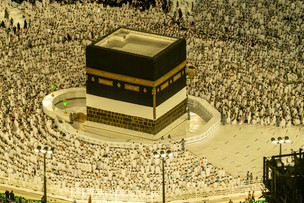
Makkah. The same desert where Ibrahim left Hajar and baby Ismail years before. Now a settlement around the Zamzam well.
The Building:
Father and son. Building together. Stone by stone.
The Qur'an says: "And when Ibrahim was raising the foundations of the House and Ismail, [saying], 'Our Lord, accept this from us. Indeed You are the Hearing, the Knowing.'" (2:127)
The Dua:
"Our Lord, make us Muslims [in submission] to You and from our descendants a Muslim nation [in submission] to You. And show us our rites and accept our repentance. Indeed, You are the Accepting of repentance, the Merciful." (2:128)
The Black Stone:
Angel Jibreel brought the Black Stone from Paradise. Ibrahim set it in the corner. We try to touch/kiss it during tawaf, following his practice.
The Call:
Allah told Ibrahim: "Call the people to pilgrimage."
Ibrahim said: "My Lord, how will my voice reach them?"
Allah said: "You call, and I will make it reach them."
Ibrahim climbed a mountain and called: "O people, your Lord has commanded you to make pilgrimage to this House."
The Response:
Every soul destined to make Hajj until the Day of Judgment responded from their future existence: "Labbayk" (Here I am).
That's why we say "Labbayk" during Hajj. We're answering Ibrahim's call. Made thousands of years ago. Still echoing.
His Legacy: Father of Prophets
His Children:
Through Hajar: Ismail (from whom came Prophet Muhammad) Through Sarah: Ishaq/Isaac (from whom came Prophets Yaqub/Jacob, Yusuf/Joseph, Musa/Moses, Isa/Jesus)
Every major prophet after Ibrahim came from his lineage. That's why he's called "Father of Prophets."
His Impact:
- Established monotheism in Arabia
- Built the Ka'bah (center of Islamic worship)
- Established Hajj rituals
- Left legacy of complete submission to Allah
- His duas were answered in his descendants becoming prophets
His Character:
Allah called him:
- Khalilullah (Friend of Allah) - the highest title
- Ibrahim the Upright
- A nation in himself
- One who fulfilled [what he was commanded]
His Mention in Qur'an:
Ibrahim is mentioned in 25 chapters. More than most prophets. His story spans many verses.
In Our Daily Prayers:
We send blessings on Prophet Muhammad and the family of Ibrahim in every prayer: "Allahumma salli 'ala Muhammadin wa 'ala ali Muhammadin kama sallayta 'ala Ibraheema wa 'ala ali Ibraheem..."
Every single prayer. We remember Ibrahim.
Lessons from Ibrahim's Life
1. Question Everything (Except Allah):
Ibrahim questioned idols, stars, moon, sun. Used his intellect. Found truth. We should use our minds to find and understand faith.
2. Stand for Truth Even If Alone:
His father rejected him. His people tried to kill him. He stood firm. Truth isn't determined by majority.
3. Leave What Keeps You from Allah:
He left his homeland. His father. Everything. For Allah. We must be willing to leave anything that distances us from Allah.
4. Trust Allah in Impossible Situations:
Thrown in fire? Trust Allah. Left in desert? Trust Allah. Commanded to sacrifice your son? Trust Allah. He did all three.
5. Sacrifice What You Love:
The willingness to sacrifice Ismail. That's real love for Allah. We must be willing to sacrifice our desires, time, wealth for Allah.
6. Build for Future Generations:
The Ka'bah wasn't just for Ibrahim's time. It's for all time. Think long-term. Build legacies that benefit people forever.
7. Make Dua for Your Descendants:
Ibrahim's duas for his descendants were answered. Prophets came from his lineage. Your duas for your children matter.
Conclusion: The Friend of Allah
Ibrahim's life wasn't easy. Every major moment was a test.
Born among idol worshippers. Rejected by his father. Thrown in fire. Left his homeland. Left his wife and baby in the desert. Commanded to sacrifice his son.
Every test, he passed. Every command, he obeyed. Every moment, he chose Allah.
That's why Allah called him "friend." Not servant. Not worshipper. Friend.
This is why we mention him in our prayers. This is why we emulate him in Hajj. This is why we sacrifice animals on his day.
As you perform tawaf of the Ka’bah, remember that Ibrahim built this.
As you drink zamzam, remember that Allah granted this water to Hajar and Ismael in their hour of desperation.
As you perform Sa’i, remember Hajar’s faith when searching for help.
As you sacrifice on Eid, remember Ibrahim’s willingness to sacrifice his son.
His story is not a part of history books. His life is an example and guidance. Demonstrating to us: This is submission. This is faith. This is what it means to love Allah more than anything else.
May Allah grant us even a fraction of Ibrahim’s faith. May Allah make us among the ones who submit in totality. And may we reply to his call: “Labbayk” not only during Hajj but throughout our lives.
Ibrahim answered every test with submission. May we do the same.
Ameen.