
Sep 17th 2026
Building Love for Salah in Children: What Actually Works
My son refused to pray Maghrib.
He was eight. He had been praying with us since he was five. He knew the rak'ahs. He knew the words. He could do it perfectly.
But that evening he looked at me from the couch and said: "Why do I have to? What's the point?"
I had two options in that moment. I could make him pray. He would — because I said so, because I'm his father, because in this house we pray.
Or I could answer the question.
I sat down next to him. I didn't turn off the TV. I didn't cross my arms. I just sat there.
"What do you think the point is?" I asked.
He thought about it. "To remember Allah?"
"Yes. And what does it do for you when you remember Allah?"
He was quiet for a moment. "I feel less scared?"
That was it. That was the whole conversation. Five minutes later he got up and prayed. Not because I made him. Because he had just remembered — in his own words, from his own experience — what salah was actually for.
That moment taught me something I wish I had known years earlier: the goal is not a child who prays. The goal is a child who wants to pray. And those two things are built completely differently.
Why Obligation Alone Is Not Enough
Muslim children are often taught salah the way they are taught to wash their hands. As a rule. As something you do because you are supposed to. As a non-negotiable.
The rule is correct. Salah is obligatory. It is the second pillar of Islam. The Prophet ﷺ said: "The covenant that distinguishes us from them is salah — whoever abandons it has disbelieved." The obligation is not in question.
But obligation, taught without love, produces compliance. And compliance collapses the moment the authority enforcing it is no longer in the room.
A teenager who prays because their parents are watching is not the same as a teenager who prays because they genuinely need that conversation with Allah five times a day. The first child has learned a rule. The second child has learned a relationship. Only one of those will hold when the child goes to university, makes new friends, faces the pressure of a world that does not share their practice.
The Prophet ﷺ himself showed us the alternative to obligation-only teaching. He told parents to command children to pray at age seven and to be firm about it at age ten — but the scholars note that the years between seven and ten are a period of gentle habituation, not strict enforcement. The gradual movement from invitation to habit to internalized love is built into the Prophetic instruction itself.
Love of salah must be built. It does not arrive automatically. And building it is one of the most important things a Muslim parent can do.
Ustadha Sumaya, who has taught Islamic studies for over thirteen years and is a mother of four, described what she has watched happen across years of working with children: "The children who sustain salah into adulthood — who pray not because they have to but because they feel something is missing when they don't — almost always have one thing in common. They encountered salah as something meaningful before it became something obligatory. They loved it before they were commanded to do it. Parents who build that love first make everything else easier."
What Children Need to Feel Before They Pray
There is a sequence that the scholars understood and that most modern Islamic parenting skips.
Before a child can love salah, they need three things.
They need to know who they are praying to. A child who has not yet developed a real, felt sense of who Allah is — not just a name, not just "the One who created everything," but someone the child feels present with, someone the child feels is actually listening — cannot pray with their heart. They can move their body through the positions. Their heart is elsewhere.
This is why tawheed — the correct understanding of Allah — is the foundation of salah love, not a separate subject. A child who knows that Allah is Al-Sami', the One who hears, and who has experienced that knowledge as personally real — when their du'a was answered, when they spoke to Allah privately and felt something — is a child who approaches salah wanting to get there. They know who is at the other end.
They need to know what they are saying. Most children pray for years without understanding a single word they recite. They perform salah in a language they do not know, repeating sounds they were taught to produce, never once understanding that Subhana Rabbiyal Adheem means "Glory be to my Lord, the Magnificent" — and that when they say it in ruku', they are standing before the magnitude of Allah and declaring His transcendence with their own mouth.
When children understand even a handful of the phrases they say in salah — when Al-Fatiha is not just an opening recitation but a conversation they are having with Allah, asking Him to guide them to the straight path and meaning it — salah becomes something entirely different.
They need to feel that salah is theirs, not just their parents'. A child who only ever prays because they were told to never quite owns the practice. At some point — gently, at the right moment — a parent needs to give the child salah as something personal. "This is your time with Allah. Not mine. Yours." That shift in ownership is what eventually makes salah sustainable.
The Early Years: Making Salah Beautiful Before It Is Required
The Prophet ﷺ said: "Command your children to pray at age seven." Seven is not the beginning. It is a milestone. The real beginning is years before.
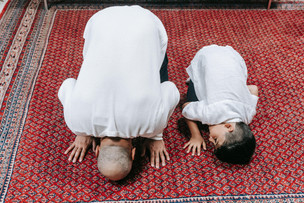
A toddler who watches their parent make sujood — who crawls under them and makes sujood too, laughing — has had their first experience of salah as something warm and close and safe. They did not learn a rule. They felt something. That feeling is the seed.
A four-year-old who stands beside their parent on the prayer mat — who imitates the movements without being required to, who feels the stillness of the house during salah, who begins to understand that this is a special time — is building an association between salah and something good.
This is the age to make salah visually beautiful. A dedicated prayer mat in a designated corner of the room. A qibla sticker on the wall. A small, child-sized mat that belongs to the child. These are not cosmetic details. They are signals. They tell the child: this matters enough to have its own space. This is real.
Manarah Publishing's Noor Al-Islam curriculum begins building the foundation for salah love from the very earliest levels — teaching salah to children as a beautiful journey that builds their connection with Allah through love, not pressure. When introduced with kindness and consistency, prayer becomes more than a routine — it becomes a source of peace, discipline, and gratitude in a child's life.
That framing — love before pressure — is the principle. The curriculum embodies it structurally. The child learns who Allah is before they learn what salah requires. They build love for the practice before they carry the weight of obligation.
Ages Six to Nine: Building Understanding Alongside Habit
Between six and nine, children are ready for something their younger selves could not process: explanation.
Why five times? The scholars explain that the five daily prayers correspond to the rhythm of the day — the beginning of light, midday, afternoon, sunset, night. Each prayer is a return. A pausing of the world to acknowledge who is running it. A child who understands this stops experiencing salah as an interruption of their day and begins to understand it as the structure around which their day organizes.
Why the specific movements? Qiyam — standing, facing Allah. Ruku' — bowing, acknowledging His greatness. Sujood — prostration, the lowest the human body can go before the Highest. A child who understands that every position has a meaning, that each one is a different posture of the heart before Allah, begins to inhabit the salah differently.
This is the age to explain what they are saying. Not every phrase. Start with one.
Start with Allahu Akbar — "Allah is Greater." Greater than what? Greater than whatever was just happening before you stood up for salah. Greater than the homework, greater than the screen, greater than the argument, greater than the worry. The moment of saying Allahu Akbar is the moment of acknowledging that whatever else is pressing on the child right now, something infinitely greater is before them.
A child who understands one phrase deeply prays differently than a child who recites everything without understanding any of it.
Noor Al-Islam at Grade 1 from Manarah Publishing begins building exactly this understanding. The Fiqh and 'Ibadah sections of the curriculum introduce acts of worship in a practical, accessible manner — not as a list of rules but as a framework for what worship means and why each act has the form it does. Grade 1 Noor Al-Islam guides learners through the pillars of Islam with emphasis on acts of worship, supporting the learner's deepening reliance on Allah.
Noor Al-Islam at Grade 3 takes this further. The Fiqh and 'Ibadah section at Grade 3 introduces acts of worship in a practical, accessible manner — covering the Sunnahs and nullifiers of Wudu, rulings related to Jumu'ah, the importance of Zakah, the etiquettes of making Du'a — with the aim of instilling spiritual discipline and integrating acts of worship into everyday life.
Integrating acts of worship into everyday life is the exact goal. Not salah as a separate religious activity. Salah as something woven into the texture of how the day runs.
The Practical Habits That Build Salah Love
Beyond understanding, love of salah is built through daily practices that most parenting books never mention.
Pray together. Not just beside each other. Actually together. Make salah a family event, not a private obligation. Call the household to prayer by saying "Let's pray" rather than "You need to go pray." The child who prays beside their parent is in the company of someone they love, doing something they have watched their parent do since before they understood what it meant. That companionship is irreplaceable.
Let children lead. When a child is old enough — around seven or eight — let them call the adhan for the family. Let them lead salah for younger siblings or cousins. The child who calls the family to prayer has been given a position of spiritual responsibility. They feel it. It changes how they relate to salah.
Make the du'a after salah real. The moment after salah — the brief space between the tasleem and rising — is a du'a moment. Show children how to use it. "Talk to Allah right now. Tell Him what you're worried about. Ask Him for what you need." A child who discovers that this moment is private and powerful will not want to skip it.
Connect salah to visible answers. When something a child prayed for arrives — a good grade, a resolved conflict, a recovered friend — name it. "Remember when you made du'a about this? Allah heard you." This is not superstition. It is making the relationship between the child and Allah visible and traceable. It teaches the child that salah is not a ritual into the void. It is a conversation with someone who responds.
What Happens at the Difficult Ages
Between ten and fifteen, salah becomes hard. For almost every Muslim child, there is a period when prayer feels like an obstacle rather than a refuge. Friends don't pray. School makes it logistically complicated. The teenage brain is pushing toward independence and pulling away from parental authority.
This is not a failure of the child's faith. It is a normal developmental stage meeting a religious requirement. And the parents who navigate it best are the ones who saw it coming and built something in advance.
A child who built a personal relationship with salah in the earlier years has a resource for this period. They know from experience — not from lectures — what it feels like to pray Fajr before the day begins and notice that the day goes differently. They know what it feels like to make sujood when something is hard. They know that salah is theirs.
That personal knowledge is not bulletproof. But it is resilient. It gives the child something to return to — and something to miss — when the habit breaks.
Manarah's Noor Al-Islam series, which runs from PreK through Grade 3 and beyond, builds this foundation systematically across the years when a child's relationship with worship is being formed. The curriculum does not treat salah as a fiqh chapter separate from aqeedah and Quran. It treats them as integrated — the understanding of Allah developing alongside the understanding of what it means to stand before Him five times a day.
Umm Yusuf, a homeschool mother who has taken her three children through the Noor Al-Islam series, described what the integration produced: "My eldest son went through a period at thirteen where praying was a struggle. But he came back. And when I asked him what pulled him back, he said: 'I felt like I was missing something.' Not 'I felt guilty.' Not 'I knew I was supposed to.' He felt like something was missing. That is what love of salah looks like. You know its absence. That is what we spent years building. It held."
The Goal We Are Actually Working Toward
The Prophet ﷺ said: "The coolness of my eyes has been placed in salah."
The coolness of my eyes. Not the obligation of my religion. Not the pillar of my practice. The rest of my heart. The place where my eyes finally find what they were looking for.
That is what we are trying to give our children. Not just the practice. The experience. The felt reality that salah is where the noise of the world quiets and something true and still is available.
That experience cannot be commanded. It cannot be enforced. It cannot be scheduled into a curriculum and delivered on a Tuesday afternoon.
But it can be cultivated. It can be modeled — by parents who pray with presence, not just performance. It can be explained — by parents who make the meanings accessible before the obligations become pressing. It can be supported — by curricula like Noor Al-Islam that build love and understanding together, never treating one as more important than the other.
And it can be prayed for. Because in the end, the tawfiq to love salah is a gift from Allah — and the best thing a parent can do alongside every other effort is ask Him to give it to their child.
The son on the couch who asked "what's the point?" grew up to be a teenager who prays Fajr before his alarm goes off.
That did not happen because I made him pray.
It happened because one evening we sat together and he remembered, in his own words, what salah was for.
Begin there. Begin with love.
Bismillah.